


National Scientific Conference “The Architecture of Lies: Consequences of Disinformation for Criminal Policy and Public Awareness” 6–7 March 2026
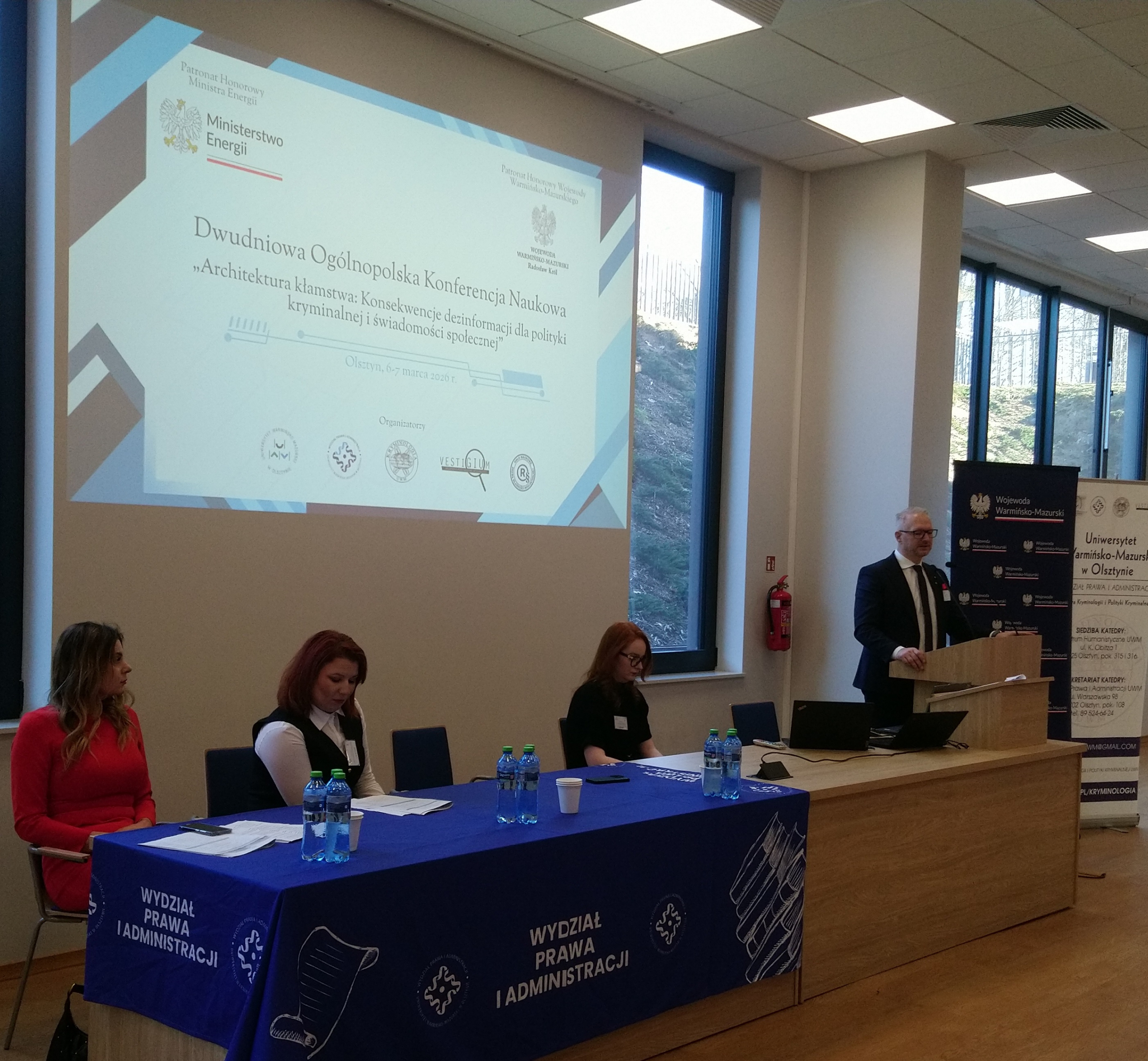
On 6–7 March 2026, the National Scientific Conference titled “The Architecture of Lies: Consequences of Disinformation for Criminal Policy and Public Awareness” was held at the Faculty of Law and Administration of the University of Warmia and Mazury in Olsztyn. This interdisciplinary event was organized by the Department of Criminology and Criminalistics, with the active support of its co-organizers: the Student Scientific Association of Criminology “Vestigium” and the Student Scientific Association of Intellectual Property Law. The conference served as a platform for academic exchange in the era of the algorithm-driven digital revolution. Its significance was highlighted by the Honorary Patronage of the Minister of Energy and the Voivode of the Warmian-Masurian Voivodeship.
During the sessions, participants conducted a multidimensional analysis of the phenomenon of deliberate information manipulation, which today extends beyond a technological issue and has become a powerful instrument influencing the foundations of the state, national security, and social relations. Speakers addressed topics such as the role of artificial intelligence in generating and combating deepfake content, the impact of disinformation narratives on the legislative process, and the sociological mechanisms shaping collective fears through manipulated messages. An important part of the discussion also concerned the protection of judicial independence in the face of organized pressure campaigns in the digital sphere.
The scale of the initiative demonstrated the strong interest in the topic. Seventy papers were presented by researchers representing 12 leading academic institutions from across Poland. The debate brought together experienced scholars and practitioners—lawyers, criminologists, sociologists, and cybersecurity experts—along with representatives of uniformed services and public administration. Special attention was also given to young researchers, for whom dedicated discussion panels were organized.
The success of the conference, which is one of several initiatives undertaken by the Department in the current academic year, provides a solid foundation for developing practical strategies to counteract the negative effects of disinformation in the public sphere. The full agenda of the event is available at: https://pdfhost.io/v/hwc5LqnsEP_Agenda_Dezinformacja_KKiK
.