Dr. habil. Denis Solodov, Professor at the University of Warmia and Mazury in Olsztyn
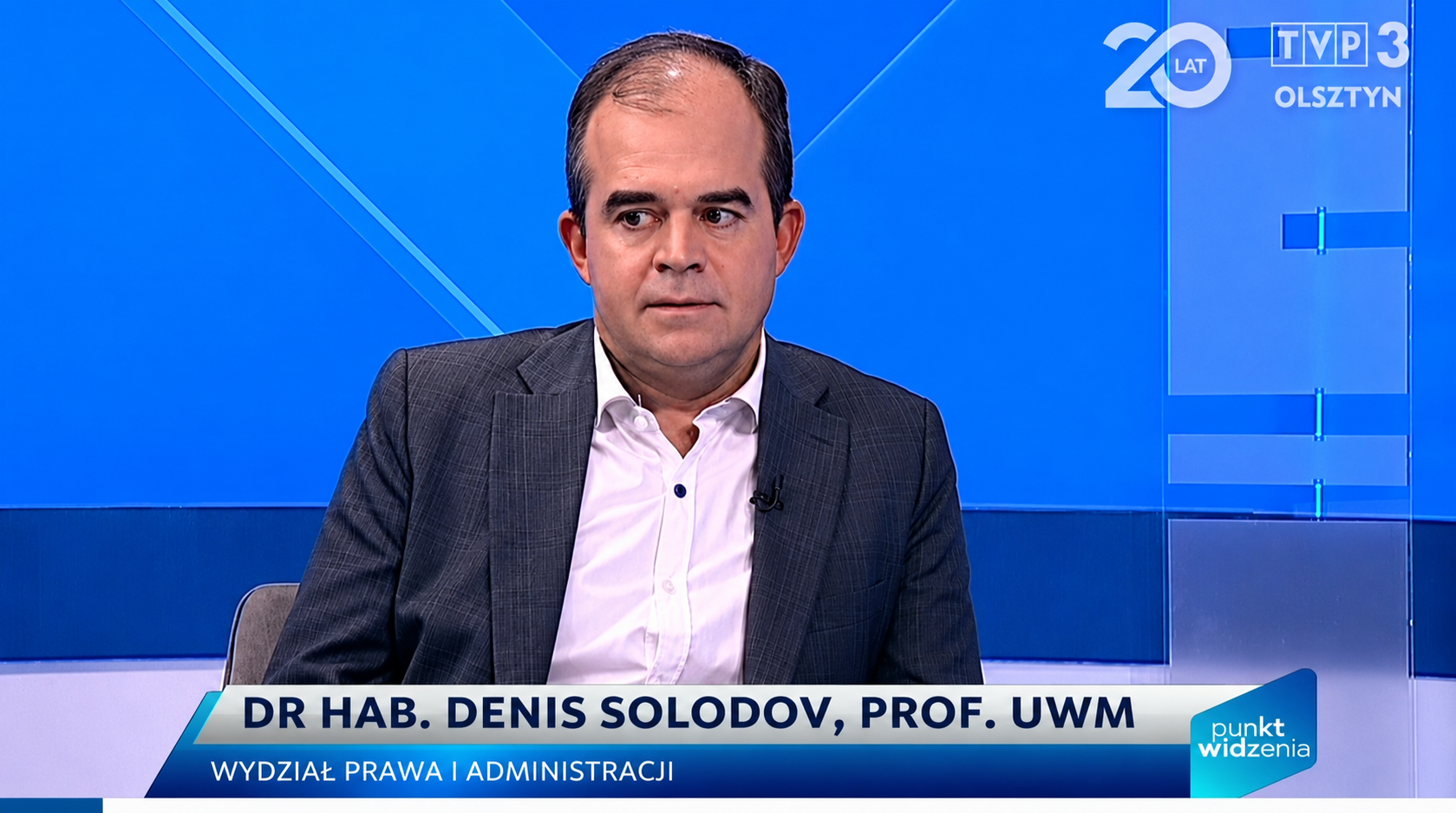
 

Dr. habil. Denis Solodov, Associate Professor at the Faculty of Law and Administration, has been working at the University of Warmia and Mazury in Olsztyn since January 2011. He is the author of more than 100 scientific publications in Polish, Russian, and English, including several forensic commentaries on the Russian Criminal Code (CC) and the Code of Criminal Procedure (CPC). Between 2000 and 2011, he worked at the Faculty of Law of Voronezh State University (Russia), where he combined academic teaching with legal practice, participating in criminal, civil, and administrative cases as well as in proceedings before the European Court of Human Rights in Strasbourg. In 2010, he obtained the academic title of Docent in the Department of Criminalistics, awarded by the State Higher Attestation Commission (VAK) under the Ministry of Higher Education of the Russian Federation. 

He completed his habilitation in 2013 at the Faculty of Law, University of Białystok, with the dissertation: „Ocena dowodów naukowych w systemie kryminalistyki rosyjskiej” (Evaluation of Scientific Evidence in the System of Russian Criminalistics). In 2014, Professor Solodov received the Professor Brunon Hołyst Award for the Best Scientific Work in Criminalistics. Since 2011, he has been a member of the Polish Forensic Science Society, and since December 2022, he has served as President of the Warmian-Masurian Branch of the Polish Forensic Science Society (Polskie Towarzystwo Kryminalistyczne). He has supervised four PhD dissertations and acted as a reviewer in seven doctoral proceedings. He is the supervisor of the Student Forensic Science Research Club "Na tropie" (since June 2011, with rebranding in November 2025).


Courses Taught / Subjects Delivered:

  • Forensics (Criminalistics)

  • Fundamentals of Forensic Tactics

  • Interrogation Techniques in Criminal Proceedings

  • 3D Crime Scene Imaging

  • Methodology of Crime Investigation

  • Digital Forensics

  • Cybercrime

  • Cybercrime and Computer Law

  • Cybercrime and Its Prevention

  • Digital Evidence in Criminal Proceedings

  • Digital Evidence (taught in English)

  • Digital Forensics (taught in English)

  • Criminal Investigation and Forensic Sciences (taught in English for Erasmus students)


Professional Development and Qualifications

  1. PhD in Legal Sciences, awarded on 1 July 2003 by the Higher Attestation Commission of the Ministry of Higher Education of the Russian Federation, based on the dissertation “Procedural and Tactical Decisions of the Investigator: Essence and Problems of Decision Optimization”, defended at the Faculty of Law, Voronezh State University, Voronezh, Russia (2003).

  2. Academic title of “Docent in the Department of Criminalistics”, awarded on 17 March 2010 by the Higher Attestation Commission of the Ministry of Education of the Russian Federation.

  3. Habilitation (Doctor habilitatus) in Law, specialization: Forensic Science, awarded on 15 November 2013 by the Faculty of Law, University of Białystok.

  4. Certified online training – UNODC eLearning Course “Investigative Interviewing (English)”, completed on 28 February 2025.

  5. Certified online training – UNODC eLearning Course “Cybercrime”, completed on 28 February 2025.

  6. Certified online training – “Detection and Securing of Fingerprint Traces in Practice” (Ujawnianie i zabezpieczanie śladów daktyloskopijnych w praktyce), completed online (120 minutes) on 10 September 2025.


Supervision of Doctoral Dissertations

  1. W. A. Kasprzak, Ślady cyfrowe. Studium prawno-kryminalistyczne (Digital Evidence: A Legal and Forensic Study), Olsztyn, 2014.

  2. M. K. Konieczny, Prawno-kryminalistyczna problematyka badań incydentów i wypadków lotniczych (Legal and Forensic Issues in the Study of Air Incidents and Accidents), Olsztyn, 2016.

  3. K. Hebda, Przyznanie się do winy. Studium prawno-kryminalistyczne (Criminal Confessions: A Legal and Forensic Study), Olsztyn, 2020.

  4. E. Lewandowska, Przestępstwo zgwałcenia: problematyka prawno-kryminalistyczna (The Crime of Rape: Legal and Forensic Issues), Olsztyn, 21 April 2022.


Research Grants and Projects (in Poland from 2011)

  1. Co-investigator, project entitled “Development of a system of legal, institutional and IT solutions to improve the search, identification, and support for families of missing persons” — implemented under the Gospostrateg Programme (Agreement No. 1/385700/7/NCBR/2018).
    Agreement for the implementation and financing of the project concluded on 8 November 2018 between NCBR (Polish National Centre for Research and Development) and the consortium including the University of Warmia and Mazury in Olsztyn. Project duration: 8 March 2019 – 30 June 2020.

  2. Member of the Management Committee, COST Action CA22128 – “Establishing Networks to Implement the Principles on Effective Interviewing for Investigations (IMPLEMENDEZ)”, project duration: 5 October 2023 – 5 October 2027.


Selected Publications

  • Bajew O. J., Solodov D. Prowadzenie czynności śledczych – kryminalistyczna analiza k.p.k. Rosji, praktyka, zalecenia dla praktyków (Conducting Investigative Actions – A Forensic Analysis of the Russian CPC, Practice, and Recommendations for Practitioners), Eksmo, Moscow 2010.

  • Solodov D. Ocena dowodów naukowych w systemie kryminalistyki rosyjskiej (Evaluation of Scientific Evidence in the System of Russian Criminalistics), Volumina, Olsztyn–Szczecin 2012.

  • Solodov D. Reformy procesu karnego w Rosji. Zarys historyczno-prawny (Reforms of the Criminal Process in Russia: A Historical and Legal Outline), Stopka, Łomża 2015.

  • Solodov D. Rola kryminalistyki w wykrywaniu fałszerstw dokumentów historycznych (The Role of Criminalistics in Detecting Forgeries of Historical Documents), Problemy współczesnej kryminalistyki, XVII, 2014.

  • Solodov D. O potrzebie znajomości kryminalistyki cyfrowej przez przyszłych prawników (On the Need for Future Lawyers to Understand Digital Forensics), Problemy współczesnej kryminalistyki, XXII, 2018.

  • Solodov D. O taktyce przesłuchania osoby przyznającej się do popełnienia umyślnego przestępstwa (On the Tactics of Interrogating a Person Confessing to an Intentional Crime), Studia Prawnoustrojowe, 41, 2019.

  • Solodov D., Sołtyszewski I. Procedura identyfikacji ofiar katastrof masowych w Rosji (The Procedure for Identifying Victims of Mass Disasters in Russia), Problemy kryminalistyki, 302, 2018.

  • Solodov D. Odpowiedzialność karna osób trzecich w związku ze stosowaniem dopingu w sporcie w Rosji (Criminal Liability of Third Parties in Connection with the Use of Doping in Sports in Russia), in: A. Dobies, W. Pływaczewski (eds.), Przeciwdziałanie patologiom na rynku medycznym i farmaceutycznym (Counteracting Pathologies in the Medical and Pharmaceutical Market), C. H. Beck, Warsaw 2019.

  • Solodov D. Prawo dowodowe w rosyjskim procesie karnym (Evidence Law in the Russian Criminal Process), in: P. Hofmański (ed.), J. Skorupka (ed.), System Prawa Karnego Procesowego, Vol. VIII/1 Dowody (Evidence), Wolters Kluwer, Warsaw 2019.

  • Solodov D. Dowodzenie w sprawach o zabójstwo bez ciała — zarys problematyki (Proving Murder Cases without a Body — An Outline of Key Issues), Nowa kodyfikacja prawa karnego, LVI, 2020.

  • Zębek E., Solodov D. Environmental Criminal Enforcement in Poland and Russia: Meeting Current Challenges, Utrecht Law Review, 16(2), 2020.

  • Solodov D., Solodov I. Legal Safeguards against Involuntary Criminal Confessions in Poland and Russia, Revista Brasileira de Direito Processual Penal, 6(3), 2020.

  • Solodov D., Solodov I. Preventing False Criminal Confessions in Poland and Russia – Legal and Forensic Aspects, Revija za Kriminalistiko in Kriminologijo, 2, 2020.

  • Zębek E., Solodov D. Environmental Forensic Inquiries in Investigating Environmental Crimes in Poland and Russia, Environmental Forensics, 22, 2021.

  • Zębek E., Solodov D. Environmental Forensic Examinations in Poland: A Case Study, Journal for European Environmental & Planning Law, 18 (2021).

  • Solodov D., Sołtyszewski I. The Search for Missing Persons in the Eastern European Countries: A Legal Procedure and Organizational Framework, Journal of Modern Science, 2(45), 2020.

  • Solodov D. A. Rape Victim Interviews in Polish Criminal Procedure, in: Dave Walsh, Ray Bull, Igor Areh (eds.), Routledge International Handbook of Investigative Interviewing and Interrogation, Routledge, Abingdon 2025, pp. 386–396.

  • Walsh, Dave, et al. A Co-ordinated Global Initiative to Enhance Interview Practice, Investigative Interviewing: Research & Practice, 15(1), 2025, pp. 7–27.


Research Interests

  • Forensic Sciences (Criminalistics) – theory and methodology of evidence evaluation, investigative tactics, and expert examinations.

  • Evidentiary Law – comparative analysis of procedural and evidentiary systems in Poland and Russia.

  • Digital Forensics – legal and practical aspects of collecting and interpreting electronic and digital traces.

  • Investigative Interviewing and Confession Analysis – modern approaches to interviewing suspects and witnesses, including the PEACE model and false confession prevention.

  • Comparative Criminal Procedure – evolution and reforms of criminal justice systems in Central and Eastern Europe.